Why starting is the hardest part
A task you can't start is rarely about laziness. Often the task is vague, the first step isn't obvious, or the whole thing feels so big that your brain can't find an entry point. Some people also wait for a feeling of readiness that never quite arrives.
The good news: you don't need more willpower. You need a smaller, clearer door.
Shrink the first step until it's obvious
Rewrite the task as a physical action you could do in under two minutes. If you still hesitate, shrink it again.
- “Do my taxes” → “Find last year's tax login”.
- “Clean the kitchen” → “Clear just the sink”.
- “Write the report” → “Open the file and write one messy sentence”.
Try just five minutes
Agree with yourself to work for five minutes and then stop if you want to. Stopping is genuinely allowed — that's what makes it work. Often momentum carries you further; when it doesn't, five minutes still moved the task forward.
Remove one obstacle first
Look for the small thing in the way: a missing password, a messy desk, a phone buzzing nearby. Fix just that one thing, then start.
- Put your phone on a shelf in another room for the session.
- Open everything you need before you begin.
- Write the very next action on a sticky note where you'll see it.
Keep only one thing in view
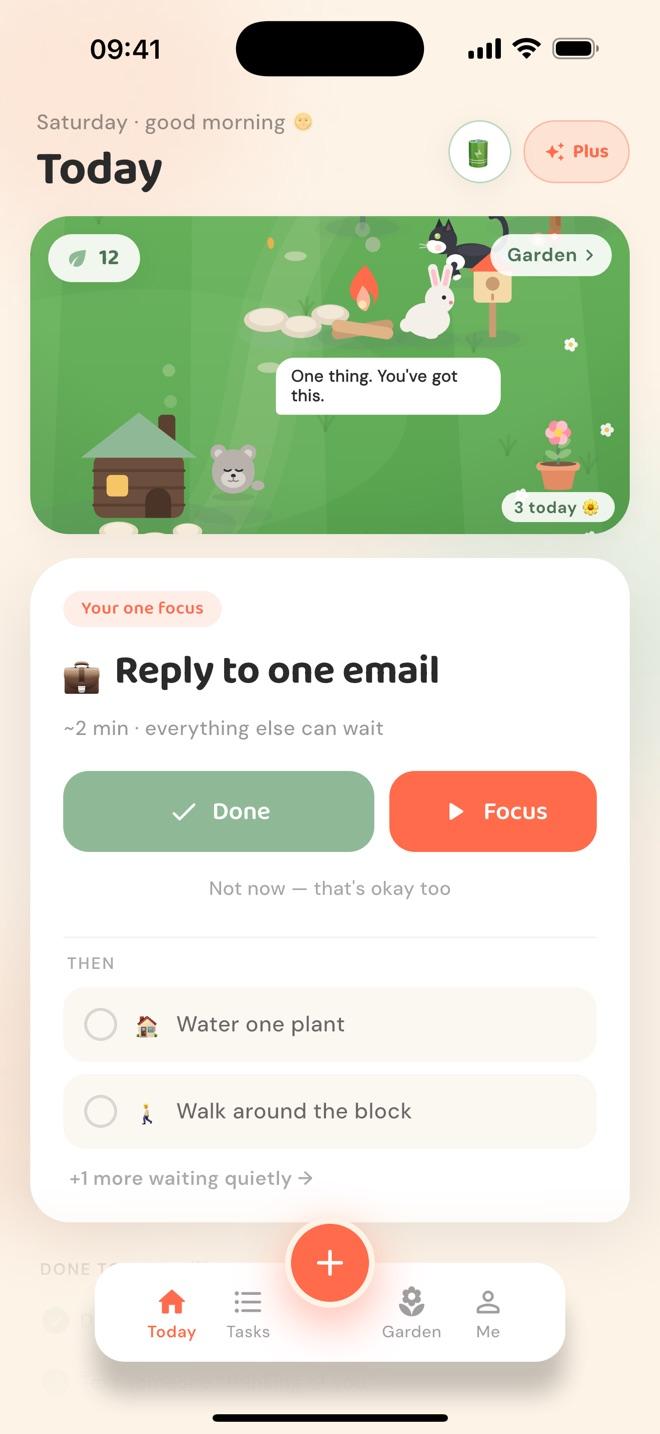
A long list makes every item compete for attention. Choose one task, hide the rest, and give yourself permission to ignore everything else until that one has started.
Be kind about what didn't happen
Shame makes the next start harder. If today didn't go the way you hoped, the most useful thing is to pick one tiny step for tomorrow and let the rest go. Rest counts too.
How Nudge helps
Nudge is built around this approach: Today shows one focus task with a five-minute start, ✨ breaks big tasks into tiny steps, and “Not now” moves a task back without guilt. Every finished step grows a seed in your garden.
